
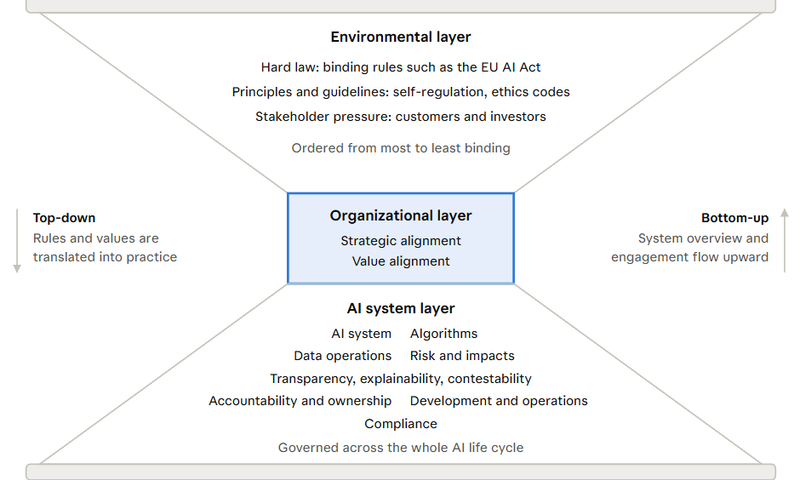
AI Governance Hourglass: How Enterprises Turn Ethics and Rules into Everyday Practice
Most companies agree that AI should be fair, safe and explainable, but few can say who does what on a Monday morning to make that true. The hourglass model of organizational AI governance, proposed by researchers at the University of Turku, answers exactly that: it shows how expectations from the outside world flow through an organization and land as concrete practices inside every AI system.
Why ethics principles alone are not enough
Over the past few years, dozens of organizations have published AI ethics principles such as fairness, transparency, privacy and responsibility. Governments are adding hard rules on top. Yet a principle on a poster does not tell a data scientist what to check before a model goes live, or tell a manager who is accountable when it misbehaves.
The researchers behind the hourglass model call this the gap between ethical principles and practice. Their answer is a simple picture: AI governance is a continuous activity of translating what the world expects into what teams actually do. That is why the shape is an hourglass.
The hourglass at a glance
Picture a real hourglass. The grains of sand are the expectations pouring in from outside: laws, ethical guidelines and public pressure. They cannot reach the bottom on their own. They must pass through a narrow middle, which is an organization, before they arrive at the AI systems at the bottom as practical, day-to-day controls.
Rules flow through the organization into every AI system
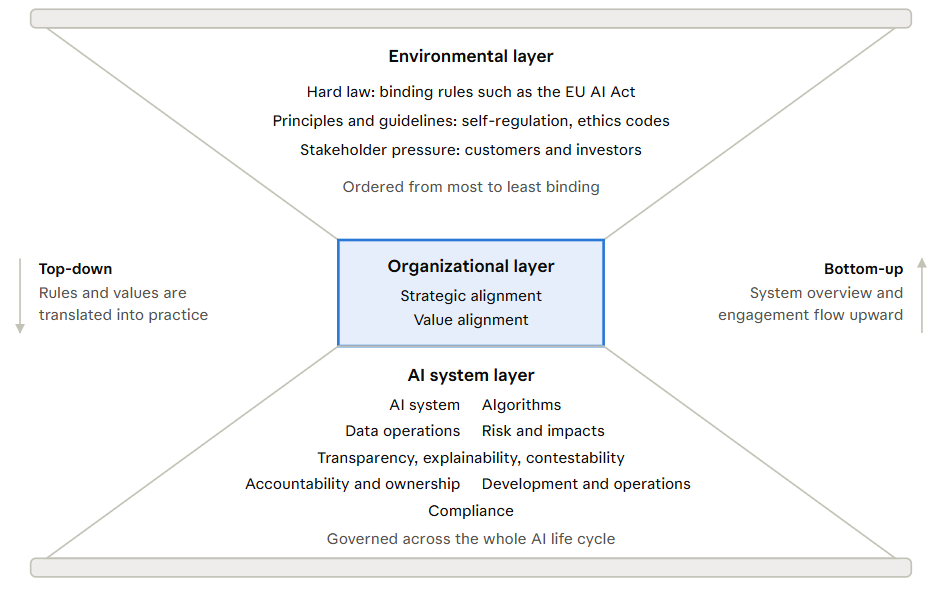
Read it from top to bottom: the world sets expectations, the organization decides what they mean for its own strategy and values, and the AI system layer turns those decisions into controls that teams can run and check.
The top: what the outside world expects
The top bulb holds everything an organization cannot control but must respond to. The paper groups it into three kinds, from most to least binding:
- Hard law. Binding rules for AI, such as the EU AI Act, plus existing data and sector rules that already apply to AI today. The regulatory picture is uncertain and fast-moving, so organizations must map which rules touch each of their AI use cases.
- Principles and guidelines. Self-regulation such as ethics codes. They broadly agree on transparency, fairness, avoiding harm, responsibility and privacy, but they can be vague or even contradict each other.
- Stakeholder pressure. Customers, citizens and investors who increasingly ask how AI is being used. The authors note this area is still young and understudied.
The neck: where the organization translates
The narrow middle is the most important part of the picture, because laws and principles do not turn into responsible AI by themselves. Leadership has to make two kinds of alignment explicit:
- Strategic alignment. Define what the organization wants AI to achieve, make sure that fits its wider strategy, and back it with management commitment, skills and training.
- Value alignment. State the values the organization stands by, decide how much regulatory and reputational risk it will tolerate, and consider how its AI systems affect different stakeholder groups. Real ethical choices involve trade-offs, for example speed versus privacy, so the risk appetite has to be written down.
The bottom: governing each AI system across its life
The bottom bulb is where governance becomes hands-on work for designers, developers and system owners. The model breaks it into eight components:
| Component | The question it answers |
|---|---|
| AI system | Is the system built, run and monitored in line with our goals and values? |
| Algorithms | Are the algorithms inside it designed, validated and monitored the same way? |
| Data operations | Where does the data come from, and is it good enough and representative? |
| Risk and impacts | What harm could this cause, and to whom? |
| Transparency, explainability, contestability | Can people understand a decision and challenge it? |
| Accountability and ownership | Who owns this system, and who oversees AI overall? |
| Development and operations | Which workflows and sign-offs govern building and running AI? |
| Compliance | Are we meeting the rules that apply, now and as they change? |
Crucially, these are not one-time checks. The paper maps each component onto four stages of an AI system’s life: planning and design, building, verification and validation, and operation and monitoring. Six of the eight need attention at every stage, including regular “health checks” once the system is live. Accountability and development operations are front-heavy: they must be settled early in the design stage.
Governance flows both ways
An hourglass is not a one-way chute. Going down, the organization processes outside requirements and implements them in its AI systems. Some requirements, such as documentation duties, apply straight to the system and skip the middle layer.
Going up, information from the AI systems keeps leadership informed about the full portfolio of AI in use. With that picture, the organization can also speak up: engaging regulators, customers and investors rather than only reacting to them.
An example: a bank’s loan-approval AI
Let’s walk one fictional company through the hourglass. Meridian Bank wants to launch LoanLens, an AI assistant that recommends approve or decline on personal loan applications so loan officers can decide faster. Finance is one of the high-risk areas the paper points to, so this is a good test.
Step 1, the top: what is expected of us? Meridian’s legal team maps the rules that touch a lending decision: non-discrimination and equal-treatment laws, data protection rules (including the right to an explanation for automated decisions) and emerging AI regulation. Customers expect fair treatment, and investors are starting to ask how the bank uses AI.
Step 2, the neck: what do we decide? Senior leaders write down a strategy (use AI to make loan decisions faster) and a value statement (without making them less fair). They also set their risk tolerance: the bank would rather slow a decision down than wrongly decline an eligible customer, and no customer is declined without an explanation. They appoint a Head of AI to oversee all AI work.
Step 3, the bottom: what do we do? The Head of AI and the LoanLens team turn those decisions into concrete controls:
| Component | What Meridian does for LoanLens |
|---|---|
| AI system | Registers LoanLens in an AI repository with a unique ID, and documents its intended use and users (loan officers) |
| Algorithms | Tests the scoring model on real-world data it was not trained on before approving it |
| Data operations | Checks that training data is relevant, complete and representative, and watches for data drift |
| Risk and impacts | Assesses potential harms up front and, with the legal team, checks outputs for discrimination |
| Transparency, explainability, contestability | Gives every decline plain-language reasons and a route to appeal to a human |
| Accountability and ownership | Names an owner for LoanLens, with the Head of AI overseeing all AI systems |
| Development and operations | Defines the sign-offs needed before each release |
| Compliance | Has the legal function review LoanLens before go-live and before major new versions, and tracks rule changes |
Step 4, the flow back up. Months after launch, monitoring flags that incoming applications look different from the training data. The LoanLens owner investigates and fixes the issue, and the Head of AI sees it in the overview of all AI systems and tells leadership. Later, a new regulation is announced. It flows back down: the legal team reviews its impact, compliance checks are updated, and the next health check covers the new requirement. That continuous loop, rather than any single document, is the hourglass at work.
Where to start: five practical steps
You do not need the full framework on day one. These steps follow the paper’s own building blocks:
- Build an AI inventory. List every AI system and algorithm you build, buy or use, and give each a unique ID.
- Name the people. Appoint a Head of AI and an owner for each AI system.
- Write down your values and risk tolerance. Decide what you will and will not accept, before a crisis forces the question.
- Map the rules. Have legal review which laws and guidelines apply to each use case, and re-check regularly.
- Govern the whole life cycle. For each system, set performance and impact metrics, monitoring, and periodic health checks, from design through operation.
Conclusion
The hourglass makes one idea easy to remember: responsible AI is not a policy you publish, it is a flow you keep running. Expectations enter at the top, leadership shapes them in the neck, and teams turn them into monitored, owned and explainable AI systems at the bottom, with information travelling back up. The authors are clear that their model is an overview and that organizations still need to do the detailed work of putting it into practice. As a starting map for decision-makers, though, it is hard to beat.
Source
Meridian Bank and LoanLens are fictional and used only to illustrate the model.
